15 Days desert tour from Casablanca. In this great Morocco tour, you will discover Morocco’s imperial cities, including Casablanca, Rabat, Fes, and Marrakech. You will also visit the Merzouga Sahara Desert and enjoy a day trip to the Atlantic coast (Essaouira). The tour concludes in Casablanca.
Upon arrival in Casablanca, you will be met by our staff and transferred to your hotel for an overnight stay.
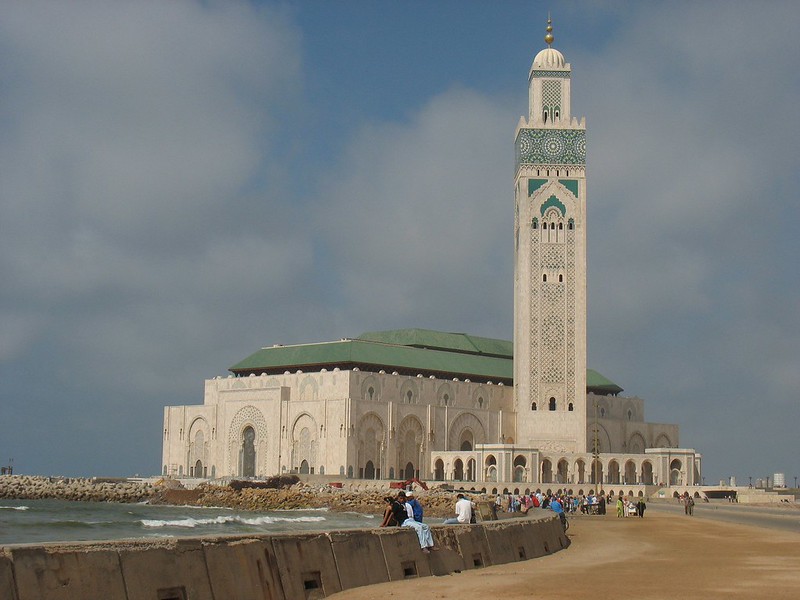
On the second day of our 15 days desert tour from Casablanca, we will first visit Morocco’s economic capital, Casablanca. After that, you’ll head to Rabat. Finally, you’ll see the Oudaya Kasbah and its lovely gardens. The Kasbah is situated at the mouth of the Abou Regreg River. It was constructed during the Almohad dynasty’s reign in 1150 AD. Also, we will visit the Mausoleum of Mohamed V and Hassan II.
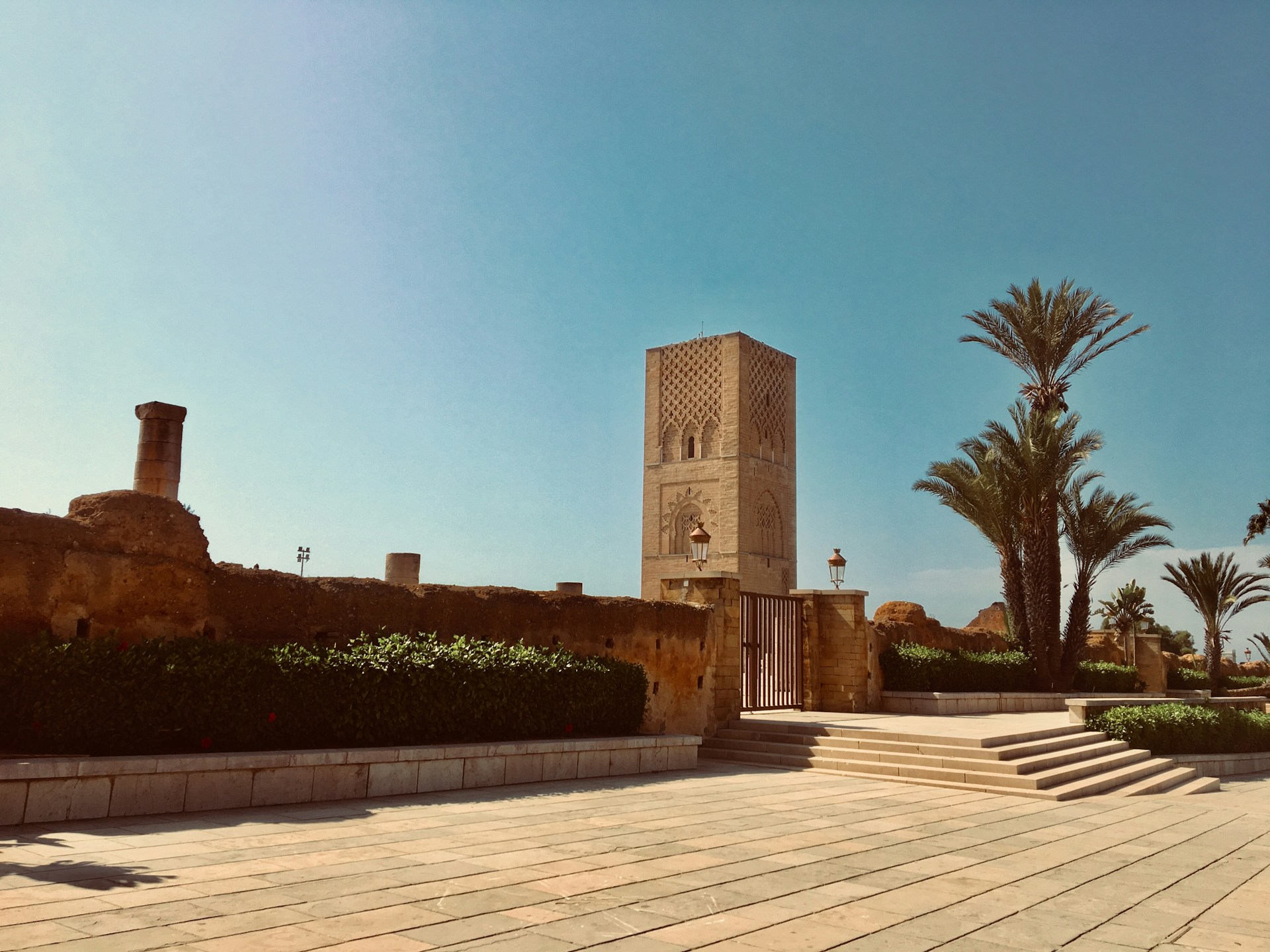
Not to mention the Hassan Tower, which is the minaret of an incomplete mosque in Rabat. It was built in 1195 AD. After finishing the sightseeing in Rabat, travel on the road to Fes. The latter is where you will be fascinated by thousands of olive oil trees and farms on both sides of the road. Check-in and overnight stay in Fes.
You will experience another adventure through the intellectual capital of Fes. The city is the Mecca of the West and Athena of Africa. It is the second-largest city in Morocco with a population of approximately 1 million people. Also, this city was the former capital and one of the country’s four imperial cities. Fes is divided into three distinct parts. Fes El Bali, or the old city, is a UNESCO World Heritage Site. There are more than 9000 narrow streets and alleyways. Fes-Jadid, also known as the New Fes, is home to the Mellah, or Jewish quarter, as well as the Ville Nouvelle, which was constructed during the French occupation. In Fes El Bali, among its narrow streets, you can find the oldest university in the world, Al-Karaouine. It was founded in AD 859, and it is still operating nowadays.
On the way to Meknes, you will go back in time to the third century by visiting the most important archaeological site in Morocco. Volubilis is the best memorial of the Roman civilisation in this part of Northern Africa. It has been a UNESCO World Heritage site since 1997. Usually, we offer a tour of 45 minutes with a local guide. From Volubilis head towards Meknes which was the capital of Morocco under the reign of Moulay Ismail (1672,1727). Stop to take pictures of the Bab Al Mansour, one of the most remarkable gates in Morocco. It was built in the eleventh century by King Al Mansour Adahbi.
You will expect to spend a long day on the road, viewing the different colours of the kingdom. On the way, you will pass through the most modern city in the country. Ifrane, the Berber name of Ifrane means caves and it is famous as “little Moroccan Switzerland”. The city is a very green town and is a ski resort in the Middle Atlas because of its high altitude of 1665 meters.
Ifrane is famous for its international University established in 1997 by The King of Morocco Hassan II. The King of Saudi Arabia, Fahd. Lunch will be in a Berber village called Midelt, which is on the foothills of the eastern part of the High Atlas Mountains. From this plateau, you will start climbing up the mountains where a large number of Berber communities live. The landscapes here include the palm tree oasis at Jbel Ayachi (at 3747 m).
After that, you will continue the drive towards the pre-Saharan zone, passing by Errachidia and Erfoud. The latter is famous for its pottery and interesting fossils, which are a major industry in Erfoud. At around 350 million years ago, the Erfoud region was a part of the huge ocean. You will be impressed by the sand sea dunes of Erg Chebbi at Merzouga appearing from the horizon. Overnight stay at the hotel.
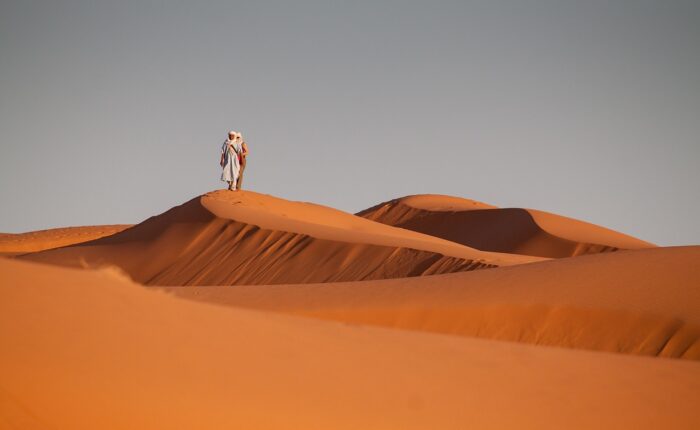
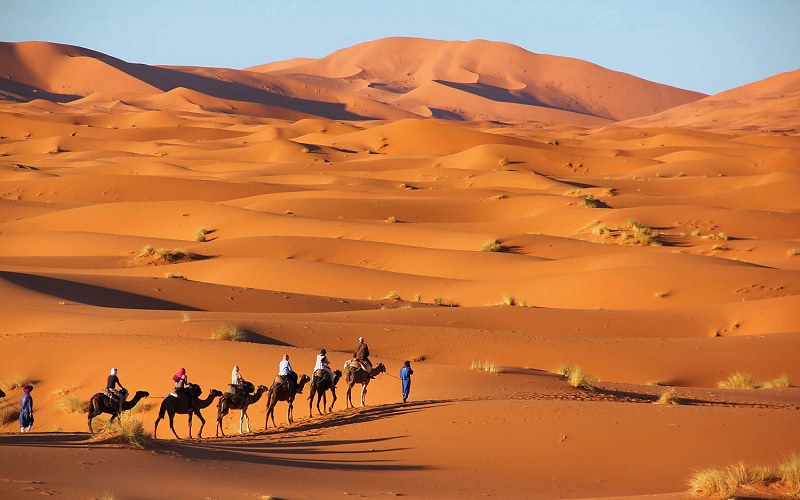
In the morning, first of all, drive through the dunes passing fabulous landscapes on the edge of the Erg Chebbi, the largest dunes in Morocco. You will see plenty of nomadic black tents in the middle of nowhere. Stop at a nomadic family to have tea and see what nomadic life looks like.
Also, you will discover the nomadic life of the Touareg people by visiting Khamlia. The latter is a village where nothing has changed for centuries. Lunch in Khamlia village or at your hotel. After a short break, we will go on a camel ride to meet one of the most fascinating sights you will ever see. The superb sunset in the middle of the high dunes of Merzouga. Overnight stay in a tent, in a desert Berber camp. Tonight you will play drums. Also, you can watch the wonderful starry sky.
In the morning. Firstly, you will visit Rissani and the Mausoleum of the founder of the Alaouite Dynasty of Morocco. This town was the ancient capital of Tafilalet and is located at the crossroads of the north and south. This elevated the city to the level of a major caravan route. Nowadays, Rissani is a commercial town with a large souk that is especially active on Tuesdays, Thursdays, and Sundays. At a distance of approximately 127 km from Rissani.
Secondly, we will explore the great canyons of Morocco. The Todra Gorges are beyond the central High Atlas Mountains. Here, the contrasting landscape reminds visitors of Colorado, with its high plateau, gorges, and great canyons. Also, its peaks are sometimes splintered by erosion. Several peaks in this area exceed 4000 m, with Jbel Saghro at 2500 m and Jbel Mgoun at 4068 m being the highest peaks in this part of the High Atlas. This area is populated by Berbers. Here you can enjoy a hike among those fabulous canyons. Overnight stay at a hotel in the same area.
From the great canyons of Todra, you will travel on the road of the thousand Kasbahs. There are massive Kasbahs on either side of the road. Several of the old fortified houses have been restored.
To begin, we will visit one of those kasbahs, Amarhidil Kasbah. You will also pass through the town of Boumalne, which is located on the edge of the Dades Valley. The latter rises in the High Atlas Mountains, sustaining a large Berber community through its productive agriculture.
Along this valley, another valley, called the Valley of Roses, appears with the green colours of its Alfalfa plants, olive trees, fig trees, and grapes. This valley gives birth to a rose from which locals produce different cosmetic products like soap, perfumes, and skin creams. Locals here celebrate this rose by organising a national festival at the end of April. Getting to Ouarzazate, (Hollywood of Africa), and the gate to the desert).
This is a city in the middle of a bare plateau, south of the High Atlas Mountains. Not to mention that it is mainly home to Berbers. the last mention constructed many of the prominent kasbahs and buildings for which the area is known. One of those buildings is Taourirt Kasbah founded in the seventeenth century. This town is famous as the Hollywood of Africa because it has been noted as a film-making location. Morocco’s biggest studios invited many international film companies to shoot their movies like Lawrence of Arabia (1962), The Living Daylights (1987), The Last Temptation of Christ (1988), The Mummy (1999), Gladiator (2000), Kingdom of Heaven (2005), Martin Scorsese’s Kundun (1997) and Babel (2005). Overnight stay at the hotel.
At a distance of approximately 35 km from Ouarzazate the fortified village of Ait Benhaddou, like a sandcastle, built in the eleventh century, lies on a hill along the Ounila River. Most of the town’s inhabitants now live in a modern village on the other side of the river. However, around five families are still living within this Kasbah. After the visit, we will drive you via Taroudant to reach the Hotel for the overnight stay, where the ninth day of our 15 Days tour from Casablanca to Merzouga Desert ends.
At a distance of approximately 70 km from Taroudant is the city of Agadir. One of the biggest Berber capitals of the Kingdom. Agadir is also a very modern city that is located on the shore of the Atlantic Ocean, at the foot of the Atlas Mountains. Also, it has the most important fishing and commercial port in Morocco. It is the first sardine port in the world, (exporting cobalt, manganese, zinc, and citrus).
It is also a seaside resort with long sandy beaches. Because of its large buildings, wide roads, modern hotels, and European-style cafes. Agadir is not the most traditional city in Morocco, but it is a modern, busy, and dynamic town and very famous for its seafood. Along the ocean, we will drive almost 200 km towards Essaouira. On the Atlantic Ocean, this town has white-painted houses with blue windows and doors, a well-designed picture. Since the 16th century, Essaouira has also famous for its Portuguese name Mogador. The Berber name means the wall, a reference to the fortress walls that originally enclosed the city. Overnight stay at the Hotel in Essaouira.
Free day in which you can decide to explore Essaouira on your own. Take a pace, or you may want to do some kite surfing and windsurfing. Other outdoor sports or activities you may want to take up are horse riding, camel riding along the beach, or quad biking. not to mention that you have to make sure to taste Essaouira’s delicious seafood too. Also, there will be time available for shopping.
In Essaouira, several small art galleries are all over the town. Since 1998 Essaouira has been famous for its Gnaoua Festival of World Music. Normally, it is in the last week of June. It brings artists from all over the world. Although focused on Gnaoua music. It includes rock, jazz, and reggae. In early 1952 the film director and actor Orson Welles made his movie Othello. Now there is a square named Orson Welles. Or you could just spend the rest of the day relaxing in your hotel.
Around halfway between Essaouira and Marrakesh, you’ll notice massive Argan trees on both sides of the road. The goats climb these trees in a charming view. Also, several women’s cooperatives help in producing many products, and it is to prepare couscous and salads. Also, it is traditionally a treatment for skin diseases before being good enough for cosmetics by European manufacturers. A stop at one of these cooperatives is worth it to see how Berber women crush the Argan fruits between their hands to extract this precious oil. Overnight stay at a hotel in Marrakech.
In the morning a full guided tour will be scheduled to discover Marrakesh. The city is famous as the “Red City”. Marrakesh is the most important former imperial city in Morocco’s history. Also, it is near the foothills of the snow-capped Atlas Mountain. Like all the old cities, Marrakech comprises both an old fortified city, the Medina, and a very modern city called Gueliz. The French occupation built its new part.
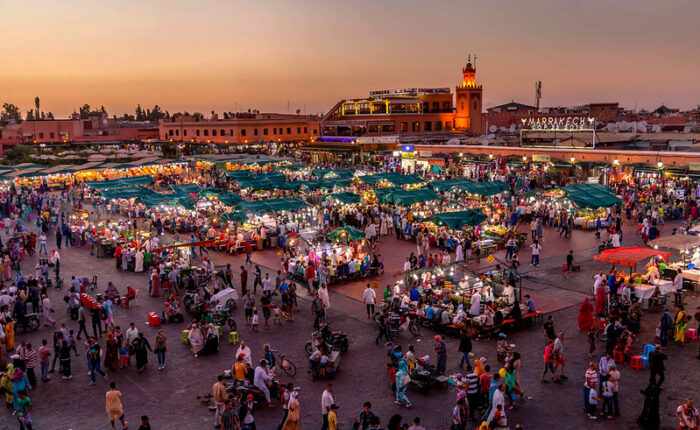
Marrakesh has the largest traditional market (souk) in Morocco. Also, it has one of the busiest squares in Africa and the world, Jamaa el Fna. The square is full of storytellers, water sellers, dancers, snake charmers, and musicians. During the night, the square transforms into a massive outdoor restaurant. During your visit to the city, you will see the Koutoubia Mosque, which was built in the twelfth century under the reign of the Almoravid Dynasty.
Not to mention that you will go through narrow streets and allies in the ancient city and will pass by “seven saints” during the reign of Moulay Ismail. The festival of the seven saints was at the request of the Sultan. The tombs of several figures were in Marrakesh to attract pilgrims. Overnight in the same hotel.
After the full guided tour. Firstly, you will be able to discover more of this Red City of Marrakesh on your own. And become familiar with the alleyways of the medina. secondly, You may go on a shopping tour on your own in a local market and the scattered shops by the Square or spend your last night enjoying the traditional Moroccan facilities of your hotel.
A private transfer from Marrakesh to Casablanca Med V airport according to your flight details will be arranged. Finally, we hope that you had a good 15 Days desert tour from Casablanca.
Fifteen days gave us the perfect opportunity to truly discover Morocco in depth. Every destination was unique and unforgettable.
From Chefchaouen to the Sahara to Essaouira, everything was perfectly organized. The desert experience was magical.
This tour includes 14 nights of accommodation, including desert camp stays.
Yes, camel trekking in Erg Chebbi dunes is included.
It is a complete Morocco experience covering cities, mountains, desert, and the Atlantic coast.
Comfortable clothes, walking shoes, sunscreen, sunglasses, and warm clothing for desert nights.
The tour ends in Casablanca or Marrakech depending on your booking option.
Yes, it is suitable for families, couples, and small groups.